
Context
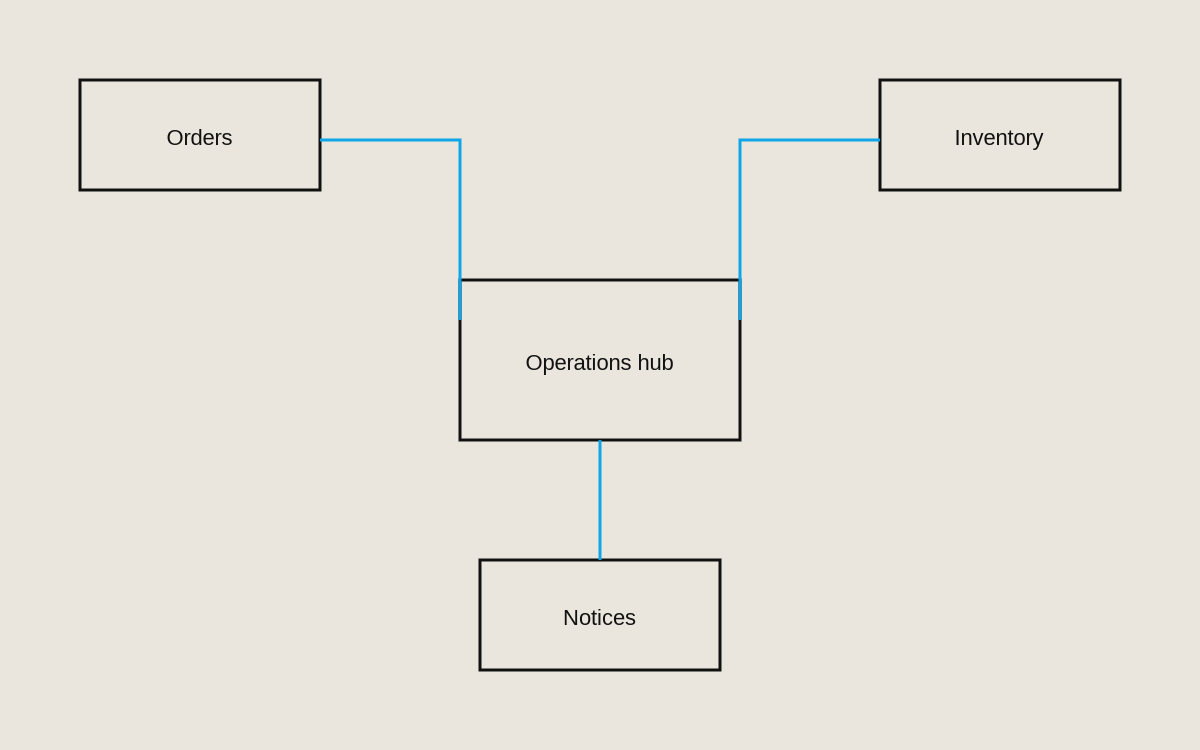
Most operations teams answer the same three questions in three different tools: What was ordered? What can ship? Who has been told? Operations Hub is a concept for one place to see those answers, sitting alongside the tools a team already relies on rather than replacing them on day one.
This page doesn't describe a client, a launch date, or usage numbers. It's a proposal for how the pieces could fit together.
Challenge
The hard part isn't the dashboard. It's agreeing on what "received", "allocated", and "notified" actually mean when every system already has its own definition. A hub that adds a fourth definition makes the problem worse, not better.
Approach
Start with one workflow, such as an order that needs stock and a customer notice. Name every event that crosses a system boundary. Let each system stay the owner of its own records, and store a copy of each event before anyone is told it succeeded.
Capabilities
The proposed hub would:
- Show the latest known state of each order, without pretending to be the system of record.
- Accept events from the tools that already run the operation.
- Hold each notification until its event is safely stored.
- Surface failed deliveries instead of hiding them behind a green status.
Technical approach
A focused web application would read from an event log. Integrations would send webhooks to an endpoint the hub owns, which verifies the sender, stores the raw payload, and only then acknowledges receipt. Downstream work, like notifying a customer, would run from the stored event and could be retried safely.
This is a proposed architecture, not a deployed system.
Outcomes
The goal is a shared, trustworthy view of one workflow, backed by a written event contract the team can change deliberately. No revenue, volume, or performance results are claimed, because this work hasn't been delivered.